How to Learn Spanish Speaking Online Fast
5 de julio de 2026
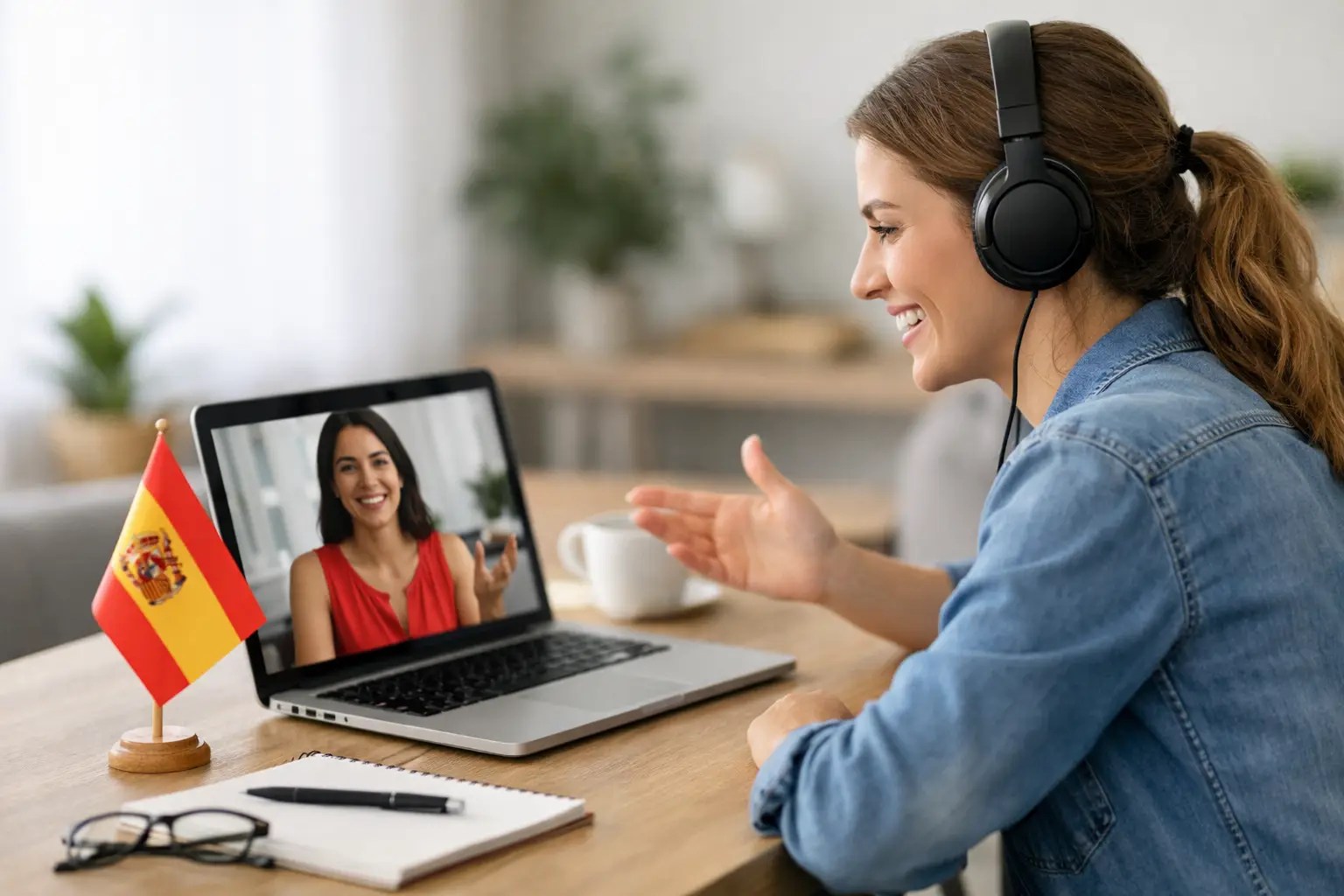
You do not need more Spanish worksheets. You need more moments where you actually say something out loud, hesitate a little, try again, and realize you were understood. If you have been searching for how to learn Spanish speaking online, that shift matters more than almost anything else. Speaking grows through use, not just exposure.
That is also why so many learners feel stuck. They can recognize words in an app, follow parts of a video, or remember grammar rules from school, but when it is time to respond in real conversation, everything slows down. The issue is rarely ability. More often, it is a learning setup that builds passive knowledge without giving speaking enough structure, repetition, or support.
How to learn Spanish speaking online in a way that works
The fastest path is not random practice. It is guided speaking practice built around material you can actually use, at a pace that matches your level. Online learning can be incredibly effective for this, but only when your study routine includes live interaction, targeted feedback, and lessons that move from understanding to real-world speaking.
If your goal is conversation, think in terms of three layers. First, you need input you can understand. Second, you need structured chances to respond. Third, you need correction and repetition so your speaking becomes more natural over time. When one of those layers is missing, progress usually feels uneven.
For example, apps can help with vocabulary and consistency, but they often stop short of spontaneous speaking. Conversation exchanges can be useful too, but without a clear plan, they can become casual chats that repeat the same basic phrases. A strong online approach combines both flexibility and structure.
Start with speaking goals, not vague motivation
Many people begin with a broad goal like “I want to be fluent.” It sounds inspiring, but it is hard to build a weekly plan around it. A better starting point is to define the kind of speaking you want to do in the next 8 to 12 weeks.
Maybe you want to introduce yourself comfortably, handle travel situations, speak with family members, or participate more confidently in work conversations. Those goals create a clearer learning path. They also help you focus on vocabulary, sentence patterns, and listening practice that support actual use instead of isolated memorization.
This matters for beginners and advanced learners alike. A beginner may need survival Spanish for daily interactions. An intermediate learner may need help moving beyond short answers. An advanced learner may want smoother pronunciation, stronger accuracy, or more confidence expressing opinions. Online speaking practice works best when it is tied to a real outcome.
Choose a program that teaches for conversation
Not every online Spanish course is designed to improve speaking. Some are grammar-heavy. Some are entertainment-first. Some are built around self-study alone. None of those are automatically bad, but they may not fit a learner whose main goal is oral communication.
Look for a program that includes live instruction, active participation, and a curriculum that builds progressively. Personalized teaching makes a real difference here because speaking challenges are not the same for everyone. One learner struggles with verb forms. Another knows the grammar but freezes under pressure. Another understands native speakers well but lacks confidence forming full responses.
A more tailored approach can address those gaps directly. That is where modern online learning stands out. When lessons are designed around your level, your pace, and your communication goals, speaking becomes less intimidating and much more practical. At Mundo Languages, this kind of personalized structure is a core part of helping learners move from passive understanding to active communication.
Build an online routine that makes you speak often
If you want to learn Spanish speaking online, your weekly routine should include more than one kind of practice. Speaking improves faster when different activities reinforce each other.
Live lessons are often the anchor because they create accountability and real-time interaction. But what you do between lessons matters just as much. Short speaking practice sessions, even 10 to 15 minutes at a time, can help you keep vocabulary active and reduce the pressure of performing only during class.
Try recording yourself answering simple prompts, shadowing short audio clips, or retelling a story in your own words. You can describe your day, explain what you are cooking, react to a short video, or summarize something you just read. These small tasks build automaticity. They train your mouth and brain to work together faster.
The key is consistency without overload. A learner who speaks Spanish for 15 focused minutes five times a week will usually gain more confidence than someone who studies for two hours once and then avoids speaking for the rest of the week.
Use AI and tech in a smart way
Technology can make online language learning more interactive and less intimidating, especially for learners who need extra repetition before speaking with a teacher or classmate. AI tools can support pronunciation practice, generate conversation prompts, and help you review vocabulary in more dynamic ways.
Still, there is a trade-off. Tech is excellent for practice, but it cannot fully replace the human side of communication. Real conversation includes unpredictability, emotion, hesitation, and follow-up questions that require flexible thinking. That is why the strongest programs use technology to support instruction, not replace it.
When AI is integrated thoughtfully into a structured learning experience, it can help learners practice more often and arrive at live sessions better prepared. That combination tends to be much more effective than relying on self-study tools alone.
Expect mistakes and make them useful
One of the biggest obstacles to speaking Spanish online is not grammar. It is self-consciousness. Many learners wait until they feel “ready” to speak more, but confidence usually comes after practice, not before it.
Mistakes are not proof that you are behind. They are evidence that you are actively building the skill. A good teacher does more than correct errors. They help you notice patterns, adjust in the moment, and keep communicating instead of shutting down.
This is especially important for heritage learners and adults returning to Spanish after years away from it. They often carry a lot of pressure. They may feel they should already know more, or they may worry about sounding unnatural. A supportive online learning environment can reduce that pressure and turn speaking into something more personal and empowering.
What to practice if you want fluency, not just familiarity
Fluency is not about using advanced words all the time. It is about expressing ideas with growing ease. To get there, your speaking practice should cover more than vocabulary recall.
You need high-frequency phrases, question forms, transitions, and sentence frames that help you keep going when your first idea is incomplete. You also need listening practice that matches your level, because stronger listening supports faster responses.
Pronunciation deserves attention too, but not perfectionism. Clear pronunciation helps confidence because it improves mutual understanding. Focus first on sounds or stress patterns that affect communication, then refine from there.
It also helps to revisit the same themes more than once. Talking about your family one week and never returning to it will not create much fluency. Talking about family, routines, preferences, memories, and plans across several lessons gives you repetition with variation. That is where language starts to stick.
How to know your online Spanish practice is paying off
Progress in speaking can feel subtle at first, so it helps to notice the right signs. Maybe you answer more quickly than before. Maybe you need less English during class. Maybe you can hold a conversation for five extra minutes without mentally exhausting yourself.
Those are real gains. So is asking better questions, recovering after a mistake, or understanding enough to stay engaged even when you miss a word. Speaking growth is not always dramatic from week to week, but it becomes very visible over a few months of steady practice.
If your current routine leaves you feeling prepared on paper but silent in conversation, it is worth changing the method. The right online learning experience should help you speak sooner, speak more often, and feel more like yourself in Spanish.
Learning to speak Spanish online can be practical, personal, and genuinely exciting when the process is built around real communication. Start where you are, speak before you feel perfectly ready, and choose a path that gives you both structure and encouragement. A language becomes yours little by little, one honest conversation at a time.
¿Quieres practicar español con una profesora?
Clases de español en vivo, privadas o en grupos de máximo 4 personas. Tu primera clase te ubica en el nivel exacto donde estás.